
Gold jewelry is timeless. It symbolises luxury, holds sentimental value, and adds a warm glow to any outfit. Yet, when shopping online or in stores, the terminology can get confusing fast. You see a stunning necklace for $50 and an almost identical one for $500.
Why the massive price gap? It usually comes down to one crucial distinction: Gold-Plated vs. Real Gold.
Understanding the difference between solid gold and gold-plated jewelry is essential for managing your budget, setting expectations for durability, and ensuring you get what you pay for. This detailed guide will break down the manufacturing processes, pros and cons, and how to spot the difference so you can shop with confidence.
What is “Real Gold” (Solid Gold)?
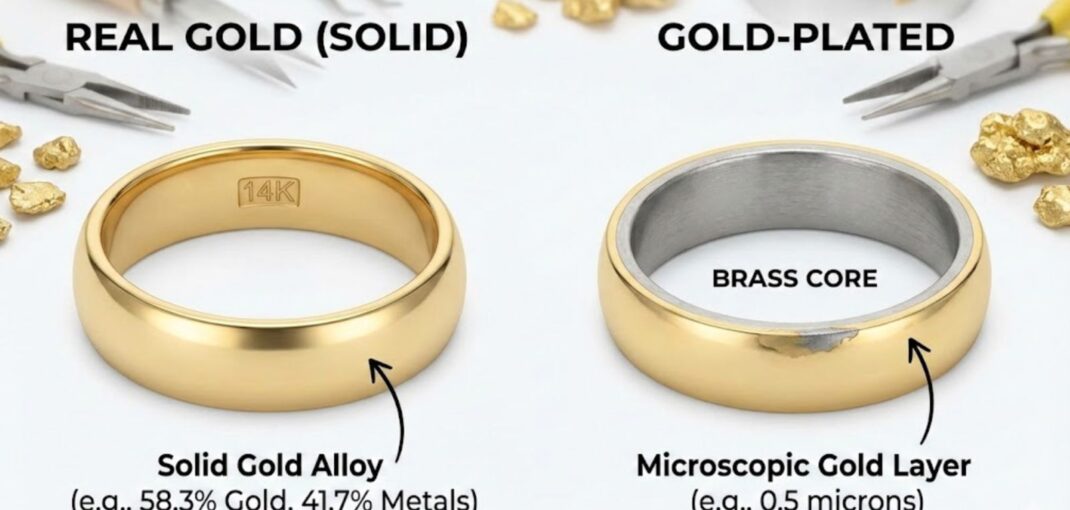
When jewelers say “real gold” or “solid gold,” they are referring to jewelry made entirely of gold alloy, inside and out.
It is important to note that very few jewelry pieces are 100% pure gold (24 Karat). Pure gold is too soft and malleable for everyday wear; it would bend and scratch easily. Therefore, “real gold” jewelry is almost always mixed with stronger base metals like silver, copper, zinc, or nickel to increase its durability.
Understanding Karats (K)
The purity of solid gold is measured in karats. The higher the karat, the more gold content it has.
* 24K Gold: 99.9% Pure Gold. The most expensive and richest color, but very soft. Rarely used for jewelry structures.
* 18K Gold: 75% Gold, 25% Alloy Metals. The standard for high-end jewelry. Excellent balance of purity and strength.
* 14K Gold: 58.3% Gold, 41.7% Alloy Metals. The most popular choice in the US for everyday jewelry (like wedding bands) due to its high durability and lower cost.
* 10K Gold: 41.7% Gold, 58.3% Alloy Metals. The minimum karatage that can be legally called “gold” in the US. It is very durable but has a paler yellow color.
The Pros and Cons of Real Gold
Pros:
* Significant Intrinsic Value: It holds market value over time.
* Durability: It lasts forever; it does not peel or fade away.
* Hypoallergenic: Higher karats (14k and up) rarely cause skin irritation.
* Low Maintenance: Can be polished repeatedly to restore its original shine.
Cons:
* Price: It is significantly more expensive than plated options.
* Softness: Higher karats can scratch or dent if mishandled.
What is Gold-Plated Jewelry?
Gold-plated jewelry is not made of gold. It is made of a non-precious base metal (such as brass, copper, or nickel) that has been dipped into a bath of electroplating solution. An electric current is used to deposit a very thin layer of real gold onto the surface of the base metal.
Think of it like a candy apple: the inside is the apple (base metal), and the outside is a thin, sweet coating (gold).
The layer of gold on plated jewelry is microscopic. In the United States, for an item to be labeled “gold plated,” the layer needs to be at least 0.5 microns thick (that’s half of one-millionth of a meter).
The Pros and Cons of Gold-Plated Jewelry
Pros:
* Affordability: It gives the “look” of real gold for a fraction of the price.
* Trendy Designs: Because it’s cheap to produce, designers use it for trendy, “fast-fashion” jewelry pieces.
* Strong Base: The underlying metals (like brass) are very hard.
Cons:
* Zero Intrinsic Value: The amount of actual gold used is negligible.
* Not Durable: The gold layer will eventually wear off, rub away, or scratch, revealing the base metal underneath.
* Tarnishing and Skin Reactions: Once the base metal is exposed, it can tarnish and turn your skin green (especially if the base is copper or brass).
Key Differences: Gold-Plated vs. Real Gold at a Glance
If you are scanning for a quick comparison, this table breaks down the vital differences.
| Feature | Real Gold (Solid 10K-18K) | Gold-Plated |
| :— | :— | :— |
| Composition | Solid gold alloy through and through. | Base metal core with a microscopic gold layer. |
| Value | High intrinsic financial value. | Very low to no financial value. |
| Price Point | High investment ($$$$). | Very affordable ($). |
| Durability | Lasts a lifetime; can be passed down. | Temporary; gold layer wears off over time (months to a couple of years). |
| Tarnishing | Does not tarnish, though lower karats may oxidize slightly over long periods. | Will tarnish once the base metal is exposed. |
| Skin Sensitivity | Generally hypoallergenic (especially 14K+). | Can cause allergic reactions or “green skin” once the plating wears thin. |
| Water Resistance | Safe to wear in the shower (though not recommended for longevity). | Should avoid water, sweat, and perfumes to extend life. |
—
The Middle Ground: Gold Vermeil and Gold-Filled
To complicate matters, there are options sitting between cheap plating and expensive solid gold.
What is Gold Vermeil?
Gold Vermeil (pronounced ver-may) is higher quality than standard gold plating.
1. The base metal must be *Sterling Silver* (not cheap brass).
2. The gold layer must be thicker (in the US, at least 2.5 microns).
It is better for allergy sufferers because the base is silver, but the gold will still eventually wear off.
What is Gold-Filled?
Gold-filled is the next best thing to solid gold. It is not “filled” with gold; rather, a thick sheet of solid gold is mechanically bonded to a base metal core using extreme heat and pressure.
By law, gold-filled jewelry must contain 5% gold by weight. It is much more durable than plated or vermeil and can last 10–30 years without wearing through.
How to Tell the Difference When Shopping
You cannot usually tell the difference just by looking at a brand-new piece. Here is how to verify what you are buying:
1. Check the Hallmarks (Stamps)
Real gold is almost always stamped with its karat quality. Look for tiny engravings on the inner band of a ring or the clasp of a necklace:
* *Real Gold:* 10K, 14K, 18K, 22K, 24K, 585 (for 14k), 750 (for 18k).
* *Gold-Plated:* GP (Gold Plated), GEP (Gold Electroplated), HGE (Heavy Gold Electroplate).
* Note: Some very cheap costume jewelry may have no stamps at all.
2. The Price Test
If it seems too good to be true, it is. A heavy, chunky gold chain selling for $45 is absolutely not solid gold. Solid gold trades based on current market prices by gram weight.
3. The Magnet Test (Not Foolproof)
Gold is not magnetic. If your jewelry sticks strongly to a magnet, it is gold-plated over a steel or nickel base. However, brass (a common base metal) is also not magnetic, so this test only identifies some plated jewelry.
The Verdict: Which Should You Choose?
The choice between gold-plated vs. real gold depends entirely on your budget, needs, and how often you plan to wear the piece.
Choose Gold-Plated If:
* You are on a tight budget.
* You are buying trendy pieces you only plan to wear for a season or two.
* You want a specific look for a single event (like a wedding or party) and don’t want to invest heavily.
Choose Real (Solid) Gold If:
* You want an investment piece that holds value.
* You are buying an engagement ring, wedding band, or staple piece you will wear every single day.
* You have sensitive skin or metal allergies.
* You want jewelry that can be passed down as an heirloom.
FAQ
Q: Does gold-plated jewelry turn your skin green?
A: Yes, it can. Once the thin layer of gold wears off, the base metal (often copper or brass) reacts with your skin’s oils and sweat, creating the dreaded green mark. Solid gold will not do this.
Q: How long does gold-plated jewelry last?
A: With daily wear, standard gold plating may only last a few months up to a year before showing signs of wear. If worn infrequently and kept away from water and perfumes, it can last a few years.
Q: Can you re-plate gold jewelry?
A: Yes. If you have a beloved gold-plated piece where the finish has worn off, a jeweler can polish off the remaining gold and re-electroplate the item.
Q: Is 14k gold “real” gold?
A: Yes. 14k gold is solid gold. It means the metal is 58.3% pure gold mixed with other durable metals. It is the most common form of real gold jewelry in the US.
Disclaimer: While we strive for accuracy, jewelry standards can vary by country. Always purchase from reputable jewelers who clearly disclose materials.