When launching or growing a jewelry brand, one of the first decisions you need to make is where to source your jewelry.
You may come across terms such as fashion jewelry manufacturer, jewelry supplier, wholesaler, OEM manufacturer, ODM manufacturer, and private label jewelry manufacturer. While these terms are sometimes used interchangeably, they can represent very different business models.
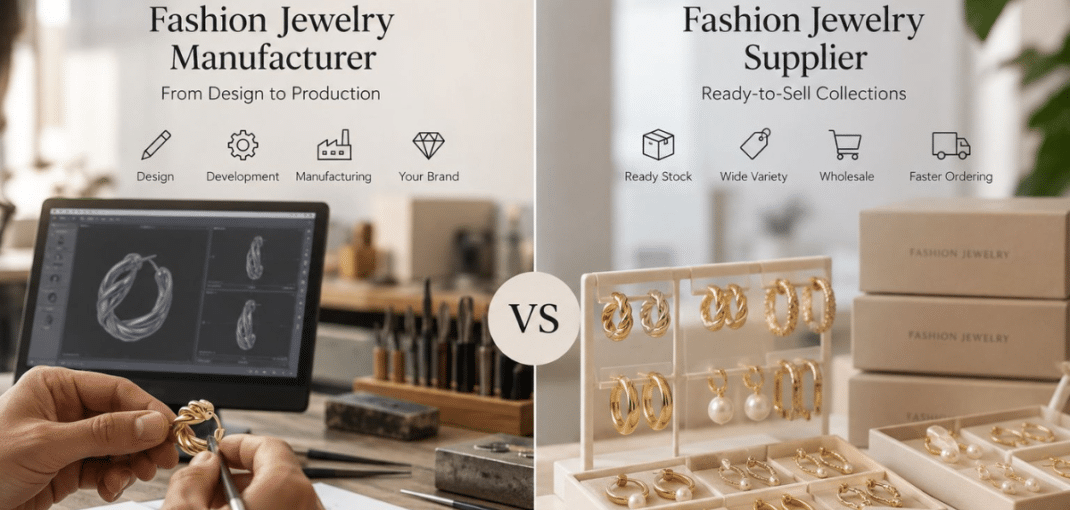
Understanding the difference between a fashion jewelry manufacturer vs supplier can help brands choose the right partner, control product quality, manage costs, develop unique designs, and scale production more efficiently.
In this guide, we explain how jewelry manufacturers and suppliers differ, when you should work with each, and what brands should consider before making a decision.
What Is a Fashion Jewelry Manufacturer?
A fashion jewelry manufacturer is a company that actually develops and/or produces jewelry products.
Depending on its capabilities, a manufacturer may manage several stages of the production process, including:
* CAD design and product development
* Prototyping and sampling
* Mold and tooling development
* Metal casting or forming
* Stone setting
* Polishing and finishing
* Plating
* E-coating and protective finishes
* Assembly
* Quality control
* Packaging and production preparation
A manufacturer can work from a brand’s existing design or collaborate with the brand to develop a new product.
For example, a brand may provide a sketch or reference image, and the manufacturer can convert it into a production-ready CAD model, create a prototype, make the required tooling, and manufacture the final product.
This makes a manufacturer particularly valuable for brands developing original or customized jewelry collections.
What Is a Fashion Jewelry Supplier?
A fashion jewelry supplier generally sources finished jewelry from manufacturers or other suppliers and sells it to retailers, brands, boutiques, or distributors.
A supplier may maintain inventory of ready-made products and offer them to businesses at wholesale prices.
The process may look like:
Manufacturer → Supplier → Retailer/Brand → Customer
A supplier may offer a large catalog of existing designs, allowing a retailer or brand to select products without going through a lengthy product-development process.
This can be useful when a business wants to purchase ready-to-sell jewelry quickly.
However, suppliers may have less control over the underlying manufacturing process because they are not necessarily producing the products themselves.
Fashion Jewelry Manufacturer vs Supplier: Key Differences
The easiest way to understand the difference is to compare their capabilities.
Factor Fashion Jewelry Manufacturer Fashion Jewelry Supplier
Produces jewelry Usually yes Usually sources it
Custom designs Often available Usually limited
CAD development Often available Usually not
Prototyping Available with many manufacturers Usually limited
Private label Common May be available
OEM / ODM Available Less common
Ready-stock products Sometimes Common
Custom plating Often available Usually limited
Production scalability High Depends on manufacturing partner
Product customization High Low to moderate
Product development support High Limited
Best for Brands developing products Businesses buying ready-made products
The right choice depends on what your business needs.
When Should You Work With a Jewelry Supplier?
A supplier can be a good option if your primary requirement is ready-made jewelry.
For example, a boutique may want to purchase 20 different earring designs, 10 bracelet designs, and several necklace styles immediately.
In this situation, working with a supplier can be convenient because:
* Products are already developed
* Samples may already be available
* No CAD development is required
* No tooling may be required
* Ordering can be faster
* You can choose from an existing catalog
A supplier can therefore be a practical solution for retailers and businesses that want to buy and resell existing products.
When Should You Work With a Jewelry Manufacturer?
A manufacturer becomes more valuable when you want to create your own products.
For example, imagine you are launching a jewelry brand and have developed a collection based on your own designs.
You may need:
* Custom CAD
* Prototypes
* Specific dimensions
* Custom metal selection
* Specific plating thickness
* Custom stone specifications
* Branded finishing
* Custom packaging
* Production in different quantities
A manufacturer can help take the product from concept to production.
The typical process could be:
Concept → CAD → Prototype → Sample Approval → Tooling → Production → Plating → QC → Dispatch
This gives the brand much greater control over the final product.
Manufacturer vs Supplier: Which Offers More Customization?
In most cases, a manufacturer offers significantly more customization.
A supplier typically sells products that have already been manufactured.
A manufacturer, on the other hand, can potentially modify the product at the production level.
For example, a brand may request:
“We like this design, but we want it 15% smaller, in stainless steel, with a different gold finish and a specific stone size.”
A manufacturer with strong product-development capabilities can evaluate these requirements and create a new production specification.
A supplier may not be able to make these changes because they are sourcing the product from another factory.
What Is OEM Jewelry Manufacturing?
OEM stands for Original Equipment Manufacturing.
In an OEM arrangement, the brand typically provides the design, specifications, or product concept, and the manufacturer produces the jewelry according to those requirements.
For example:
Brand Design → Manufacturer → Finished Jewelry
OEM manufacturing is particularly suitable for brands that already have their own designs and want a manufacturing partner to produce them.
What Is ODM Jewelry Manufacturing?
ODM stands for Original Design Manufacturing.
In an ODM relationship, the manufacturer can contribute to product design and development.
The manufacturer may provide design concepts, technical development, prototypes, and production support.
This model can be useful for brands that have a general creative direction but want manufacturing and product-development expertise to help turn that direction into finished products.
What Is Private Label Jewelry Manufacturing?
Private label manufacturing allows a business to sell products under its own brand name.
The manufacturer produces the jewelry, while the brand handles areas such as:
* Branding
* Marketing
* Packaging
* Distribution
* Retail
* Customer relationships
Private label manufacturing can be particularly attractive for startups and retailers that want to launch their own jewelry collection without establishing their own factory.
Which Is Better for a Jewelry Startup?
There is no universal answer.
It depends on your business model.
Choose a Supplier If:
You want:
* Ready-made jewelry
* Existing designs
* Faster purchasing
* A broad product catalog
* Smaller quantities of available products
* Minimal product development
Choose a Manufacturer If:
You want:
* Original designs
* Custom jewelry
* Product development
* CAD and prototyping
* Custom plating
* Private label manufacturing
* OEM or ODM production
* Long-term production scalability
If your goal is to build a differentiated jewelry brand, working directly with a manufacturer can provide greater control over the product.
What About Buying Houses?
Jewelry brands may also work with a buying house or sourcing agency.
A buying house typically acts as an intermediary between the brand and manufacturers.
The model may look like:
Brand → Buying House → Manufacturer → Brand
Buying houses can help with sourcing, vendor management, quality control, production coordination, and communication.
However, brands should understand who is actually manufacturing their products.
When evaluating a sourcing partner, ask:
“Do you manufacture the jewelry yourself, or do you source it from other factories?”
This simple question can provide important clarity.
Why Direct Manufacturer Relationships Can Benefit Brands
Working directly with a manufacturer can provide several advantages.
1. Better Product Development
You can communicate directly with the team responsible for turning your design into a physical product.
This can reduce misunderstandings during development.
2. Greater Cost Transparency
You may have greater visibility into factors such as:
* Metal
* Weight
* Labour
* Plating
* Stones
* Tooling
* Packaging
This can make product costing easier to understand.
3. More Control Over Quality
Direct communication with the production team can make it easier to establish quality standards and specifications.
4. Faster Product Iteration
When CAD, sampling, production, and finishing capabilities are coordinated, design changes can often be handled more efficiently.
5. Easier Scaling
Once a product becomes successful, a direct manufacturing relationship can make repeat production and scale-up easier to manage.
What Should You Ask a Jewelry Manufacturer Before Working With Them?
Before placing an order, brands should ask several important questions.
Product Development
* Do you offer CAD development?
* Can you manufacture from sketches or reference images?
* Can you create prototypes?
* Can you modify existing designs?
Materials
* Which metals do you manufacture?
* Do you work with brass?
* Do you manufacture stainless steel jewelry?
* Do you work with 925 silver?
Plating
* What plating options do you offer?
* What plating thicknesses are available?
* Do you offer e-coating?
* Can you match specific colours and finishes?
MOQ
* What is your minimum production quantity?
* Do you offer low-MOQ sampling?
* Can sample quantities differ from production quantities?
Quality
* What quality-control processes do you follow?
* How do you check plating consistency?
* How are finished products inspected?
Production
* What is your typical development timeline?
* What is your production lead time?
* Can you scale production for successful products?
Commercial Terms
* How is costing calculated?
* What are the payment terms?
* What happens if a sample requires modifications?
The more clearly a manufacturer can answer these questions, the easier it is to evaluate whether they are the right fit.
Manufacturer vs Supplier: Which One Should Your Brand Choose?
The answer ultimately comes down to your business model.
If you need… Consider
Ready-made jewelry Supplier
Existing designs Supplier
Quick catalog selection Supplier
Original designs Manufacturer
Custom jewelry Manufacturer
CAD development Manufacturer
Prototyping Manufacturer
OEM production Manufacturer
ODM development Manufacturer
Private label collection Manufacturer
Long-term production partner Manufacturer
For a business simply looking to buy jewelry and resell it, a supplier may be the right choice.
For a brand looking to develop unique products, control specifications, build its own collection, and scale production, a direct manufacturing partner is often the better option.
Yunova Lifestyle: From Design to Production
At Yunova Lifestyle, we work with jewelry brands and retailers as a design-led manufacturing and product-development partner.
Rather than simply supplying existing products, we support brands throughout the product-development and manufacturing process.
Our capabilities include:
* CAD & Product Development
* Brass, Stainless Steel & Silver Manufacturing
* Premium Plating & E-Coating
* Custom Finishes & Colour Matching
* Low-MOQ Sampling
* Scalable Production
* End-to-End Quality Control
* OEM / ODM Manufacturing
Our Jaipur-based operations combine established jewelry manufacturing expertise with modern product-development and production capabilities.
Whether you have an existing CAD file, a physical reference, a sketch, or simply a product concept, our team can work with you to develop it into a production-ready piece.
Final Thoughts
The difference between a fashion jewelry manufacturer and supplier ultimately comes down to their role in the product lifecycle.
A supplier primarily helps you source existing products.
A manufacturer can help you develop, customize, manufacture, and scale products.
Neither model is inherently better. The right choice depends on your business objectives.
If your goal is to build a differentiated jewelry brand with your own designs and specifications, finding a capable fashion jewelry manufacturer can give you significantly more control over product development, quality, pricing, and scalability.
If you are looking for a manufacturing partner for your next jewelry collection, prototype, or private-label project, Yunova Lifestyle can help take your product from concept to production.
Have a design or product requirement?
Share your design, reference image, or specifications with our team to discuss development, sampling, and manufacturing options.
Yunova Lifestyle
Jaipur, India
Fashion Jewelry Manufacturing | OEM | ODM | Private Label